When AI Meets Its Limits: An Operator’s View on Quantum Drug Discovery
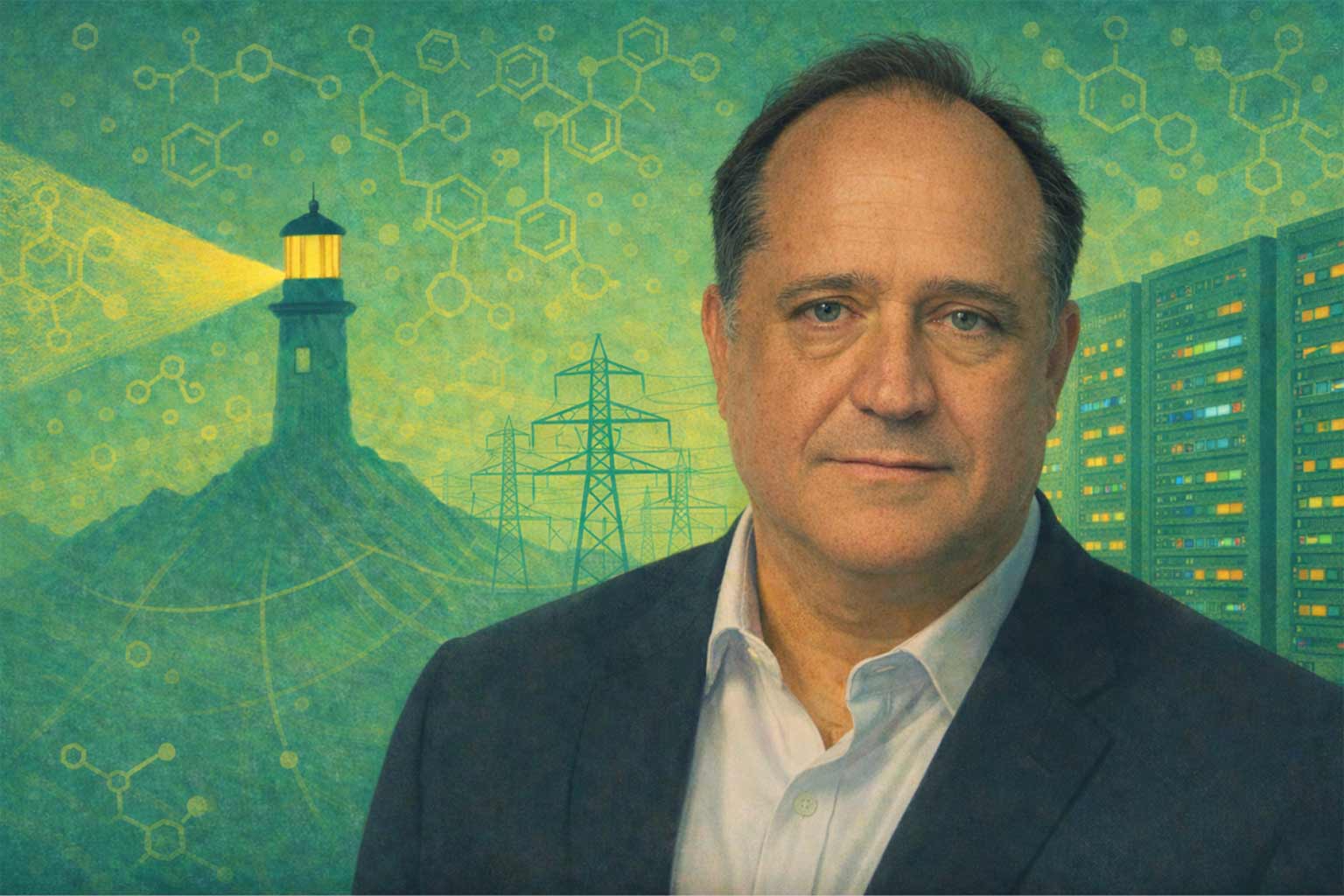
Artificial intelligence is reshaping nearly every industry, including drug discovery. But as AI models grow larger and more computationally demanding, a quieter question is emerging behind the headlines: What happens if the infrastructure can’t keep up?
Data centers already consume staggering amounts of energy and water. In parts of the country, they’re straining local grids and water resources. The promise of AI is enormous, but so are its demands.
For most companies building in computational drug discovery, more progress means more compute, more servers, more power, and more scale. Keinan Ashkenazi, investor and Board Director at FAR Biotech, sees it differently.
Over two decades, he has built and exited companies across different industries. He is not a physicist or computational chemist, but an operator: someone who evaluates strategy, risk, capital efficiency, scalability, and real-world consequences.
In this series, we’ve heard from fellow directors Dr. Martin Martinov, the biophysicist behind QuantumAI, and Max Duckworth, the strategist focused on partnerships and growth. Keinan offers the perspective of an investor who asks where the rubber meets the road.
In this conversation, he explains why he chose to back FAR Biotech at inception, how he distinguishes real scientific differentiation from marketing noise, and why he believes quantum mechanics, not brute-force AI, may offer a more sustainable path forward in drug discovery. Because breakthrough science doesn’t exist in a vacuum. It has to work in the real world.
You’ve built and exited companies in completely different industries. Why would someone with your background choose to get involved with a computational drug discovery company? What did you see here that made it worth your time?
KA: That’s a two-pronged answer. First off, the main company I started and sold was in financial services: international payments. I wasn’t really into venture capital, investing, or start-ups beyond my own. I never saw things from an outside investor perspective.
Over the years, though, I’ve evolved. Now, when I invest, I focus almost more on the person, or the people, than the product or service. If you came to me and said, “I’m starting something,” I might invest because I know you and trust you.
I have a saying: the wrong person can turn Facebook into ****, and the right person can turn **** into Facebook. It’s really about the person.
There are clues I see in pitches, red flags or green flags, that tell me whether to lean in. And that brings me to Martin.
Martin always impressed me: his knowledge, who he is as a person, and what motivates him. From an investor standpoint, he wasn’t saying, “I want to be the next multi-billionaire.” He was genuinely trying to help mankind. We can also make money along the way, but that wasn’t the only driving force. He’s a brilliant mind who believes deeply in what he’s built. That’s who you invest in.
Because frankly, good luck explaining the platform to me in granular detail. What do I really know about protein pockets and molecular interactions? I had to bet on the jockey. I had to trust that he was the right horse in the race. It wasn’t really “drug discovery” that pulled me in. It was Martin.
Now, I wasn’t completely unfamiliar with the medical space. I was an early investor in a medtech company that went public. I’ve been around diagnostics and biotech companies that made it to IPO. But I’m not going to pretend I fully understood everything Martin was talking about at a deep scientific level. At a high level, yes. But what really impressed me was him, and that’s why I invested.
For someone outside biotech, can you paint a real-world picture of what’s broken in drug discovery today? If you had to explain the problem over dinner, what does it actually look like in practice?
KA: At a high level, drug discovery has always been extremely expensive and time-consuming. It’s evolved over decades, really centuries, with chemists, biologists and now, physicists, refining the process. As computational power has improved, things have gotten more efficient. But is it “broken”? I don’t know if broken is the right word. Maybe the better question is: could it be much more efficient?
That’s where quantum mechanics comes in, and that’s the basis of Martin’s platform. What I find interesting is this: FAR has always been a QuantumAI company. When I first got involved, AI was just becoming a buzzword. Then suddenly everyone and their mother was an AI company.
Now quantum is becoming the new AI. Everything is quantum. I joked the other day that I’m getting emails about “quantum golf clubs.” It’s become a buzzword. But we’ve actually been doing quantum from the very outset.
So instead of asking, “What’s broken?” I’d ask: what’s not working as well as it could? And how do we tackle that? We tackle it through a quantum methodology.
When you look at FAR’s QuantumAI platform, what changes in practical terms: timeline, capital efficiency, risk profile?
KA: The big differentiator is this: Most people hear “quantum” and think “quantum computing.” But quantum computing doesn’t really exist in a meaningful commercial sense yet. Maybe in government labs like NASA or the Department of Defense, but not broadly in the commercial space.
Think of quantum computing as hardware. What Martin has built is more like the software layer that makes quantum-level thinking usable today. His platform takes what quantum computing promises, which most companies can’t actually access, and translates it into software that can run on today’s computers. And the output is comparable, if not better, than what people are trying to achieve with massive infrastructure.
The other key piece is resources. AI is powerful, but it’s resource-intensive. Data centers consume enormous amounts of water and energy. I live in Northern Virginia: it’s basically data center central. Each one is powering a small city. At some point, we hit limits.
FAR’s platform can do quantum-level modeling with a fraction of the resources—not 10% less, but potentially orders of magnitude less. That’s not just elegant science: that’s capital efficiency, sustainability, and scalability.
Many investors are cautious about computational drug discovery because outcomes are hard to predict. What gave you conviction that FAR’s approach wasn’t just theoretical?
KA: One of my biggest fears as an investor was this: what if someone with unlimited resources—Google, Amazon, whoever—throws $10 billion at this problem and blows past us? But what I’ve come to understand is that you can throw unlimited money at something, but if you don’t truly understand it or have the correct theory, you can’t replicate it.
There are probably only a handful of people on the planet who deeply understand what Martin and our bioinformatics team are doing at the quantum level. That’s the real differentiator.
And then there’s the validation. When scientists who work at major pharma companies, whose job is to evaluate platforms like this, say, “We’ve seen them all, and FAR sees what others can’t,” that matters.
When you look at FAR today, what is the one thing you think people most misunderstand (or most need to understand) about the company?
KA: If I had to answer bluntly? People underestimate Martin. He’s not a polished, Nobel-Prize-circuit academic. He’s not wrapped in prestige branding.
I tell friends: imagine having the best soccer player in the world in your barn—cut-off jeans, no cleats, kicking around a cloth ball. Give him the right equipment, and field, and you’ve got Ronaldo or Messi. That’s how I feel about Martin.
The talent is there. The platform is there. But investors and pharma want to see you far down the field before they commit. And getting there is expensive and time-consuming.
If you asked me what to understand about FAR, I’d say: understand the talent behind it. Bet on Martin. The platform flows from that.
Can you elaborate on your earlier comment about AI and resources?
KA: AI is only as good as what you feed it. That’s something Martin told me early on. If you feed AI flawed assumptions, you get flawed output. What we’re feeding our deep learning AI is complete and rigorous quantum mechanics: the fundamental physics of molecular interactions. That’s the difference.
And as AI scales, resource constraints will become real: energy, water, infrastructure. Quantum mechanics allows us to achieve quantum-level modeling without quantum-level resource consumption. That’s a big deal.
You invest in breakthrough science. What kinds of healthcare problems are worth pursuing, even when they’re technically hard and commercially uncertain?
KA: Any problem that meaningfully helps people. Cancer. Mental illness. Neurodegeneration. The diseases that devastate families.
If we can use this platform to make a dent in those areas, even if they’re technically hard or commercially uncertain, that’s worth pursuing. It may sound like a pageant answer like “world peace”, but it’s real. If we can help mankind and improve lives through better drug discovery, that’s the mission.
Listening to Keinan, one theme comes through clearly: behind every breakthrough technology are people willing to ask hard questions about whether it will actually work in the real world. His perspective as an operator, investor, and long-time advisor brings a grounding influence to a field often filled with hype. At FAR Biotech, where physicists and strategists are pushing the boundaries of computational drug discovery, that practical lens matters. We’re grateful to have Keinan as part of the team, and for the clarity he brings to the conversation about what it takes to turn ambitious science into something that can genuinely improve lives while delivering risk-adjusted financial returns.


