What We Invent Here, and What We Build Here: Maggie Brickerman on Wisconsin’s Next Chapter
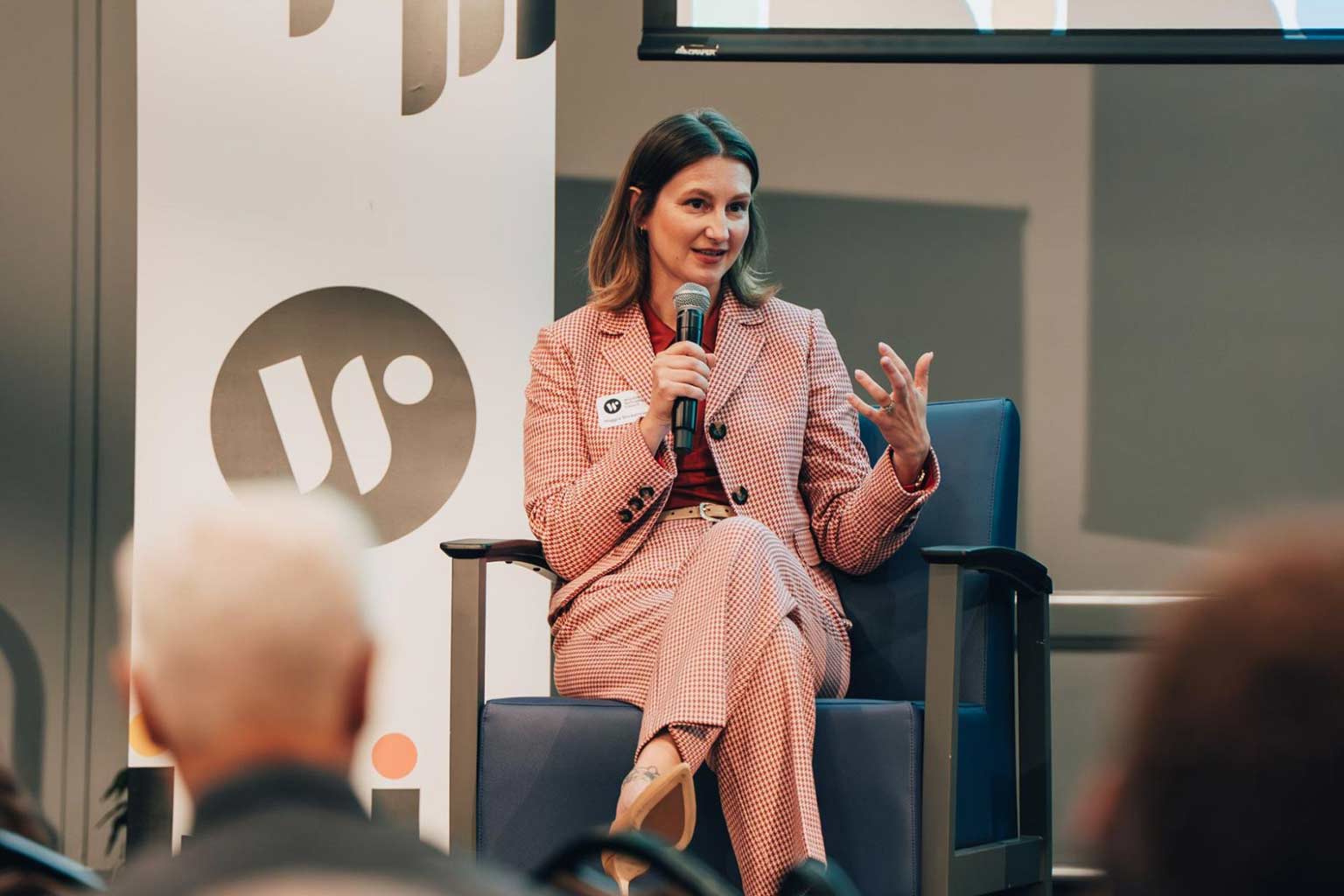
Wisconsin’s innovation economy is entering a consequential moment. The state already has deep strengths in research, biotechnology, manufacturing, higher education, and entrepreneurship. At the same time, emerging fields such as quantum, fusion, biomanufacturing, and autonomy are posing new questions about where Wisconsin can lead and what it will take to turn scientific and technical strength into companies, jobs, and enduring economic growth.
Few people sit closer to those questions than Maggie Brickerman. As president of the Wisconsin Technology Council, Brickerman leads an organization that serves as a statewide connector among entrepreneurs, investors, researchers, corporations, and policymakers – with a mission centered on growing and retaining science- and technology-based businesses in Wisconsin. Before taking the role, she spent more than a decade at gener8tor, where she helped to grow the organization from a small startup into a national platform supporting thousands of companies. Earlier in her career, she worked in Wisconsin politics—experience that still informs how she thinks about coalition-building, policy, and getting ambitious ideas across the finish line.
That combination gives Brickerman a particularly wide-angle lens of what makes innovation ecosystems work.
In this conversation, she shares why Wisconsin’s size can actually be an advantage, what the state still needs to do to connect research more closely with industry, and why public-private partnerships will be increasingly important. She also reflects on the qualities she has seen in the strongest founders, how she approaches technologies she doesn’t fully understand, and why Wisconsin needs to prepare now—not later—for the workforce demands of fields like quantum.
Her perspective is both practical and optimistic: Wisconsin has many of the ingredients it needs. The opportunity now is to connect them more intentionally, and make sure that what is invented here is also built and grown here.
You started your career in politics before moving into entrepreneurship and innovation. How has that experience shaped the way you approach your work today?
MB: I started my career in campaign politics here in Wisconsin, and Madison was an incredible place to do that. With city, county and state government all here—and Wisconsin playing such an important role nationally—there were a lot of opportunities to get involved early.
Campaign politics is also a really great career for a young person. It has the same kind of feel as a startup—a different mission at the end of the day, but you’re really starting something from scratch, growing a team, raising money. That adrenaline and excitement, and the thrill of execution, was the thing I loved about that work. As a young person, I also thought it was a really good, high-impact way that I could have a positive impact on the place where I grew up and that I love and care about deeply.
After about a decade, I realized it’s a very hard lifestyle. As I started thinking about wanting to have a family, it wasn’t always a good match. So I met with many champions and mentors of mine and said, “I have this really unique skill set of creating a plan, executing against it, building relationships—all the things that go into doing that successfully. Where could I take this set of skills and add value someplace else?”
I was introduced to one of the co-founders of gener8tor, Joe Kirgues. I showed up and he talked for the better part of an hour, and I understood maybe 60% of what he said. I feel like I’m a smart person, but there was something about the energy, the passion and the mission that got me really excited. So I kind of showed up at gener8tor and never left.
I wasn’t intending for that to be a decade-plus. I knew I was joining a company that helped entrepreneurs, but I did not realize that I was going to become an entrepreneur. There were only four of us at the time, and when I left 11 years later, there were about 120. The company had grown to have operations in 50 cities, mostly in the U.S. but also internationally.
That experience as an entrepreneur—helping to create new products, find new partnerships and scale a company—was invaluable. In this latest role, I have the benefit of combining both of those experiences: having worked with elected officials and understanding the basics of how a bill becomes a law, but also the relationships it takes to get things done; and having a really strong perspective on how we can grow our innovation economy in Wisconsin and what our ecosystem needs to get to the next level.
It’s an exciting combination of those two things that has brought me full circle to the Tech Council.
From your perspective, what makes Wisconsin distinctive as a place to build science- and technology-driven companies, and where does the ecosystem still have room to grow?
MB: When it comes to science and technology, we have a couple of incredible assets. One is, of course, our research institutions—our universities and private research foundations that are inventing and commercializing new technologies.
We also have an incredible amount of innovation, R&D and product development happening within private companies. Sometimes those innovations grow the existing business, but it’s also not uncommon for them to spin out into companies of their own. There’s just so much exciting invention taking place in Wisconsin.
And when you think about starting companies here, we have some really strong advantages. It’s affordable to do business here, and employees can afford to live here. You can move to the Bay Area or Boston, but how high do salaries need to be for people to support their families in those communities? Wisconsin has an incredible cost of living, but also amazing amenities as a state. People love living here.
I also think that what we lack in size, we make up for in density. These innovation ecosystems are close-knit. People know each other, and there’s a real pay-it-forward mentality. People are constantly introducing each other. In the Bay Area, you can go to a coffee shop and there might be 16 VCs around you. We don’t have that here, but you can get to who you need to get to because people are willing to open their Rolodex and put in a good word.
In terms of how we take it to the next level, I think there are opportunities to draw the research and innovation ecosystem closer to industry in Wisconsin. There are already really interesting examples of that happening—industry-university research consortia, institutes at UW–Madison that engage industry, and collaborations between corporations and academia in Milwaukee.
But holistically, if you look at where research and development are happening and where industry is, there’s still a gap. It’s not anyone’s fault. We just have to be intentional about creating those intersections, especially when it comes to emerging technology.
A company might think, “Tell me when I need to pay attention.” The answer is: now. You need to pay attention now and actually be part of developing it.
If we can draw those things closer together, we can help make sure that what gets invented here benefits industry and workers here—and that the companies created here stay here.
What opportunities do you see for government to help strengthen Wisconsin’s growing biohealth ecosystem, and are there examples of public-private partnerships that you think have worked especially well?
MB: I think we’re all thrilled about the launch of the EDA Biohealth Tech Hub. That was an incredible effort that had state involvement—not only from the standpoint of investing in helping the ecosystem compete for it, but also in bringing people together and building the relationships necessary to make that happen.
It’s a great example of what public-private partnership can look like. There were industry partners at the table, including both large companies and startups, along with the broader ecosystem led by BioForward, which is really the glue that holds all of that together.
From my seat at the Tech Council, I think the important thing is that we don’t stop and say, “We got the Biohealth Tech Hub—call it a day.”
We don’t have infinite opportunities, but we do have a range of areas where we can build those kinds of dense ecosystems. I think there’s more work for us to do as a state to identify places where we have an emerging technology strength and a core industry, and where those things together can create some kind of differentiated advantage that we can rally around.
When we can do that, the folks with the big dollars from federal grant-making agencies want to come to the party.
For people who might not be familiar with the Wisconsin Technology Council, what role does the organization play in Wisconsin’s innovation ecosystem, and what are your top priorities in the role?
MB: The Wisconsin Technology Council has a unique history. It was created through State statute in 2001 with bipartisan support to serve as the official science and technology advisor to the governor and legislature, specifically with the mission of growing and retaining science- and technology-based businesses in Wisconsin.
That’s still our lens today. We do a lot of policy, advocacy, and advisory work around what ingredients and support are needed to grow this sector of the economy. We also serve as a membership organization with a really diverse group of stakeholders whose interests overlap around innovation, science and technology, and economic development.
That includes academic institutions, startups, large companies—particularly those focused on technology, innovation and R&D—investors, and the whole constellation of experts who support the ecosystem, from attorneys and bankers to HR companies. We do a lot of convening across those groups to help people build relationships, identify priorities and roadblocks, and communicate those needs to policymakers.
From a priority perspective, I’ve been thinking a lot about which gaps no longer exist, in part because of foundational work the Tech Council has helped support over the past 20 years. Things like Qualified New Business Venture tax credits, which have helped spur investment activity, and the statewide business plan contest, which we’ve rebranded as Launch Wisconsin, helped build some of that early-stage infrastructure.
So the question now is: What has that progress produced, where are the gaps today given the maturity of our ecosystem, and where is the Tech Council especially well suited to help fill them?
One area I think about a lot is the federal funding landscape. There’s so much emphasis now on public-private partnerships, consortia and groups rather than funding single organizations or researchers. As a statewide, nonpartisan nonprofit and neutral convener, we’ve already found opportunities to bring people together to pursue bigger opportunities than they could on their own.
Ultimately, that can lead to more resources to support the creation of companies and help them scale. And once those companies get started, they need capital, customers and specialized talent. Figuring out where we can help strengthen those assets is a big part of what we’re thinking about.
You’ve said you’re not afraid to ask questions when you don’t understand something. When you’re evaluating emerging technologies, what questions do you tend to ask first?
MB: I think it depends on who you’re talking to. More often than not, with the things we’re particularly focused on in frontier technology or deep tech, the founders, inventors or PIs tend to be very technical—and I love that.
That was always one of the things that brought me the most joy at gener8tor: meeting with someone where I didn’t have expertise in what they did, and sometimes even feeling a little intimidated going into the conversation. But once you get into it, you realize you can ask the right questions to understand enough to be helpful.
And often, there was something I could offer them as well. They might be incredibly technical, but maybe they didn’t know as much about raising capital, hiring people or getting an introduction to the right person. Finding those relationships where we each had something to offer the other was one of the most satisfying parts of that work.
When I’m meeting someone and trying to understand what they’re doing, especially if they’re coming from a highly technical or academic background, they’re often used to talking about their research or how the product works. I try to get them to lift their head up and ask: But why? What’s the application of this? Why does it matter that it works?
They know the answer. It’s often just a matter of teeing them up with the right question.
My brain also completely runs on analogies. One of the benefits of spending 11 years at a sector-agnostic venture firm was seeing so many different kinds of companies. You can draw on all of those experiences to help understand something new, and I think that kind of curiosity goes a long way.
So I’m always trying to understand: What’s the real-world application? Why does it matter that this product exists and that it works?
When I was making investment decisions or evaluating companies in my previous role, another really good sign was if I could immediately think of the first five mentors I’d introduce them to or the first five investors who might be interested. It was about connecting the dots beyond just, “What is it?” and “Why does it matter?” to, “How can I help you grow?”
A lot of my work has been helping super-technical people with that other half of the equation: You have a product, but you also need to build a business. I used to joke that my job was to simplify what they were doing as much as possible, and their job was to stop me when it was no longer correct. Then we’d meet in the middle—and that was usually the perfect way to describe the company to a general audience.
Having helped support more than 1,600 companies through gener8tor, what patterns have you seen among founders who are especially effective at turning ambitious ideas into companies that can attract capital and partners?
MB: How much time do we have?
I think there’s a really unique balance that the most successful founders are able to strike between having a strong perspective and point of view, and also being open to collaboration, feedback, and the possibility that they might be wrong about something.
It’s delicate. If you’re so opinionated that you can’t hear feedback or accept help, it’s going to be really hard to build a company, because it takes not just a village, but a city and a state to do it. But if you’re too flexible, you can get into this whiplash mode where you do whatever the last person you met with suggested, and things get messy.
You have to find that balance. Sometimes that comes from getting it a little wrong in either direction, and from finding trusted people who can be sounding boards as you make those decisions.
The other thing I would describe as “pulling all the threads.”
I’ve worked with founders who go into a meeting with a preconceived notion of who you are, what you know and how you might be able to help them. If it becomes clear that you’re not going to write them a check, or you’re not a buyer, or you’re not whatever they expected, they can sort of shut down.
The best founders go in with a much more open mind. They may have an idea of how you could add value, but they listen to what you’re saying and start to see the other possibilities.
You can almost visualize six threads laid out on the table, and they start pulling them: “I’m going to ask you for this introduction. I’m going to follow up on this thing you said that made me curious.” Out of almost any conversation, they can figure out a way to find mutual benefit.
These are more personality traits than anything else, but I think that willingness to meet people with an open mind—and to see opportunities that might not be obvious going into the conversation—is really important.
When you look across emerging technologies today, what developments or areas are you paying the closest attention to and why?
MB: From a Wisconsin perspective, I think we have an incredible opportunity. Biotech is obviously a huge strength for us, and the snowball is rolling. We have to continue to attend to it and focus on it—but not stop there.
I get really excited about places where we have some kind of emerging technology strength. Quantum, of course, is one that I’m super excited about. Fusion has incredible momentum. There are also really interesting things happening in biomanufacturing, ag bio, and autonomy—whether that’s drones or even the technologies that power them. Those areas have implications for agriculture and manufacturing, but also for defense. The list goes on.
If you think about previous iterations of what startup ecosystems looked like, there’s something different about many of these deep-tech companies because they’re often building very physical things. That creates a different kind of stickiness to Wisconsin, and I think that’s where we have a real opportunity.
It’s not only about what we can invent here. If we do it right, what can we build here that creates incredible advantages for the entire state and makes it a total no-brainer for these companies to keep building in Wisconsin?
As you look at the next five to ten years, what would you most like Wisconsin to become known for?
MB: I think it’s really the intersection between emerging technology, our incredible manufacturing base, and the constellation of workforce development assets we have here.
We have our research universities, the comprehensive University of Wisconsin System campuses that touch all parts of the state, private institutions that have incredible agility because of how they’re structured, and one of the strongest technical college systems in the country.
When you think about how a deep-tech startup grows, many of these companies start with PhDs. As their teams expand, they begin hiring people with master’s degrees and four-year degrees, and eventually many of the jobs they create are for technicians and people with two-year degrees or certificates.
We have the entire spectrum here to support that—not only for Wisconsin, but I think for the region as well.
But we have to be thinking about it now and planning for it now. If we wait until it’s super obvious that there are tens of thousands of jobs in quantum, it’ll be too late.
Is there anything else you want to add?
MB: I just love Wisconsin, and I’m so happy every day because I get to meet with people who are so excited and optimistic about what we can do here.
Thank you to Maggie Brickerman for taking the time to share her perspective on Wisconsin’s innovation ecosystem, the technologies shaping its future, and what it takes to turn ambitious ideas into companies that can grow and thrive. We’re grateful for her thoughtful insights—and for the work she and the Wisconsin Technology Council are doing to help connect and strengthen the state’s innovation community.
Note: This interview was lightly edited for readability.


